LSM
2024-6
2+ years
The retainer
Liberty Specialty Markets (LSM) is a specialist and commercial insurance provider with a global footprint, I have been the primary designer on the account for more than 2 years. The work spans a mixture of BAU design tickets — ranging from minor block updates to full section redesigns with an end-to-end process — as well as larger strategic projects outside the retainer scope, such as introducing personalisation to the UK site.
My role
As the primary designer on the account, I worked under the oversight of Ben, day to day I worked closely with the product owner on the client side, our in-house development team, a CRO data specialist, and our project manager.
The problem space
Two issues shaped my early time on the account. The first was pace: the design process had become too research-heavy, and the client wasn't seeing results quickly enough. The intention in bringing me on wasn't to skip research altogether, but to move through it with a lighter touch — running leaner discovery phases and accelerating into UX and UI without losing rigour where it mattered.
The second issue was the design system itself, which had grown cluttered and bloated over time and no longer reflected the CMS accurately. Naming conventions were inconsistent between the two, making internal processes cumbersome, and a significant number of blocks in the design system had never actually been built and weren't available in the CMS at all.
Redesigning the careers section
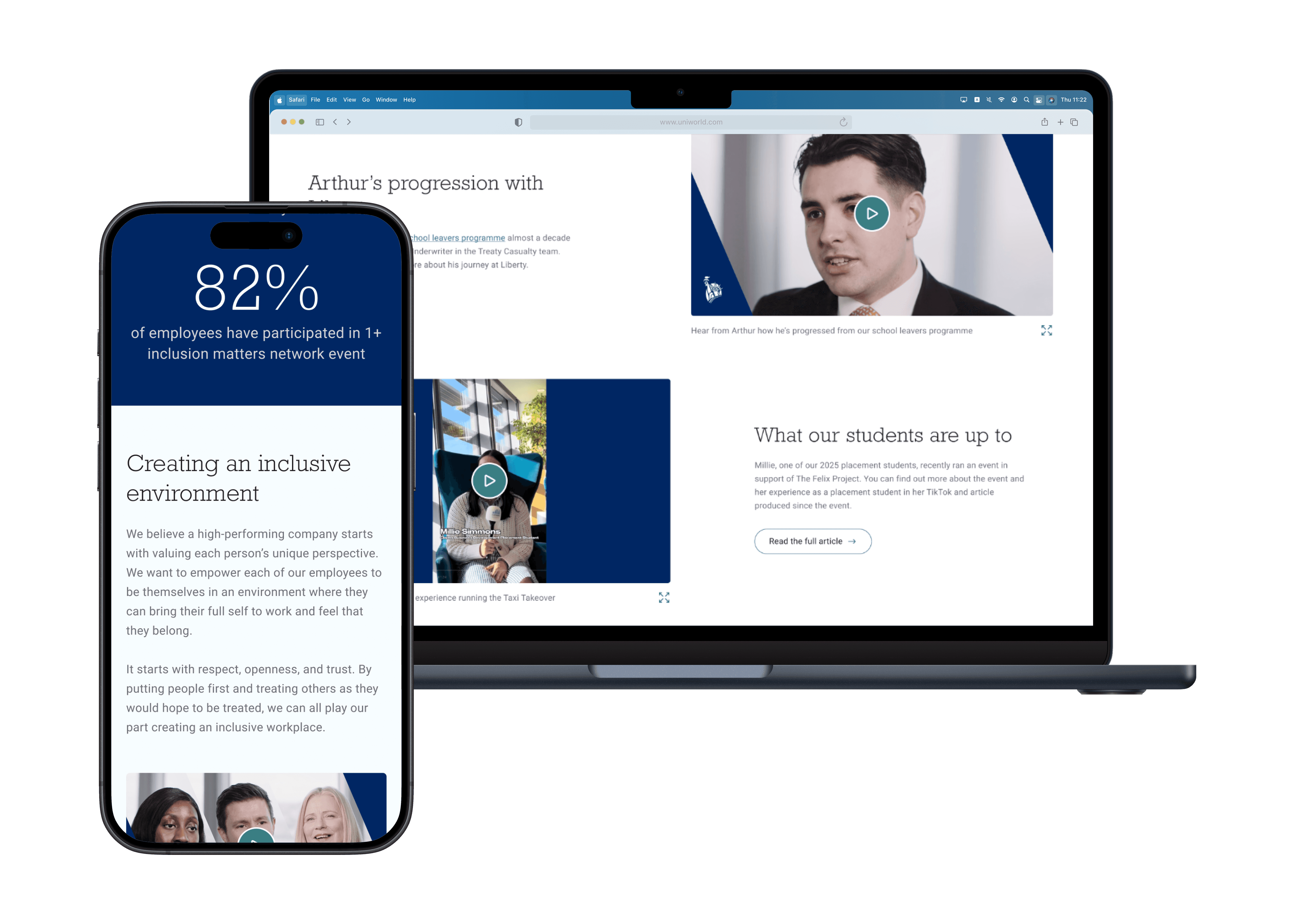
One of the more substantial BAU tickets was a full redesign of the careers section. The goals were to better represent LSM's early careers programmes, make the section genuinely useful and informative for students and graduates exploring their options, and give all prospective employees — at any career stage — a clear picture of what working at LSM looks like, covering benefits, learning opportunities, and DE&I.
Because the site can be personalised for three distinct user personas as well as a general view, the process began with creating four separate information architecture structures for the section — one per persona plus the default. From there I moved into low-fidelity wireframes for each page, designing with both early-careers and later-career job seekers in mind throughout. I built each page using existing blocks from the design system, flagging where a new or updated block could meaningfully add value rather than forcing content into something that didn't quite fit. This resulted in four new blocks being designed into the system alongside three updates to existing ones. The work concluded with full annotation and handover documentation for the development team.
Refining a mobile table design
During a larger project to bring the Singapore and Hong Kong sites onto the same tech stack as the UK and Global sites, a specific design challenge emerged. Product pages in these regions frequently featured large, text-heavy tables with accordion-style expandable rows — and the existing mobile experience was poor, requiring horizontal scrolling with no sticky elements to anchor the user.
Tables on mobile are a persistent pain point, but I was confident there was a better solution: redistributing the table information vertically so that mobile users could navigate it with only vertical scroll, as they'd naturally expect. After researching the problem I found a UX TV video that validated the approach and put the theory into practice clearly. From there it was a case of integrating the existing accordion-style row behaviour into the new layout, and producing meticulous documentation for the development team to explain how the functionality should work across states.
How the ways of working evolved
Two relationships improved significantly over the course of my time on the account, and both had a meaningful impact on how the work got done.
The first was with the development team. We moved away from a traditional hand-off model and began involving developers much earlier in the design process — often bringing our back-end developer in at the very start of a ticket to problem-solve together. Given the complexity of the Liberty CMS, which manages multiple sites, regions, and themes simultaneously, this meant technical constraints and limitations surfaced early rather than arriving as surprises after design was complete. I could then design with those realities in mind from the beginning, which made handovers smoother and reduced rework on both sides.
The second was with the client. I joined the account specifically because the previous designer wasn't moving fast enough, so rebuilding trust was part of the brief from day one. Over time, I developed a strong working relationship with the product owner on the client side, selectively bringing her into the design process at moments where her input genuinely added value. For larger projects we introduced workshops as a regular touchpoint, the relationship evolved to a point where we could collaborate openly, work through disagreements constructively, and move quickly with confidence on both sides.
Reflection
Working on this retainer over an extended period has been one of the more formative experiences of my career as a designer. Early on, I worked closely with Ben, our directing oversight, brainstorming problems together and ensuring he had visibility and sign-off on work before it reached the client. Over time that dynamic shifted — I took on a much more leading role, leaning on Ben for support when I needed it rather than as a default step in the process. I became trusted to steer the account more independently, collaborate directly with the development team and the client, and own the design work in a much fuller sense. That gradual shift from supported to self-directed is something I've felt clearly, and it's shaped how I approach ownership and collaboration on any project since.